What Guides You Through Life?
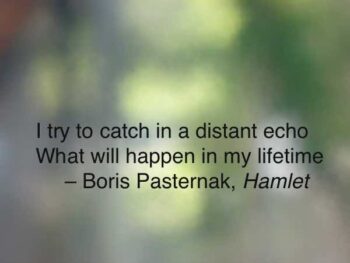
I’m guided by a signal from the heavens
I’m guided by this birthmark on my skin
I’m guided by the beauty of our weapons
– Leonard Cohen, First We Take Manhattan
Over dinner someone mentioned kismet – the eastern word for ‘fate’. “That’s why I’m here.”
There are many reasons why we end up where we are.
Our lives are filled with choices. Some are small and insignificant. Others are momentous and life-changing.
Small choices in a game of tennis can set you up to win the point after maneuvering your opponent into a difficult position.
Small choices can be cumulative – and although we don’t like to admit it, they usually are. Choices such as whether to eat the extra treat. Whether to skip that extra ten minutes of exercise.
Leonard Cohen, the master poet, in these three concise lines, gives us an insight into the major factors that guide most of us, for most of our lives.
Let me start with the last one.
“The beauty of our weapons” can refer to all the mechanisms we have created to help us navigate our lives. This includes: all our skills and capabilities, our jobs and how we answer the question “What do you do?”, as well as all that we own and manipulate in order to survive, such as our phones, our homes and our ‘toys’. These are our ‘weapons’ to help us get through, get with, and get on in life. And – we can get caught up in their beauty and power, and be captivated by their beauty.
And while these ‘weapons’ may be useful in helping us to get through life, they are poor ‘Guides’ for our life.
“This birthmark on my skin” refers to all the inherited cultural influences of family, our genetic structure, and the society into which we are born and grow up in. This is as much a part of us as a birthmark. For many people our culture and heritage can serve as a Guide in life, and one that is rarely examined, because it is so natural and therefore seems so ‘right’.
The challenge with a ‘birthmark’ being our guide is how we relate to all the other different and conflicting ‘birthmarks’ in the world, and how we ‘live, and let live’.
“A signal from the heavens” can be interpreted as everything ‘above’ the plane of human existence – all our religious beliefs and convictions, everything from beyond our ability to know with provable certainty or to question. It includes all that we aspire to in a life beyond this life, and all that we hope for – for ourselves, and for one another. It includes what we perceive as ‘divine’ and beyond our right to question. Perhaps something like fate, or destiny.
Is there another way of being guided?
A fourth way of being guided is by a deeper self-knowledge and insight into what really ‘works’ for us – an awareness of what it takes to be in harmony with our true values and nature.
I believe this is the real contribution that modern psychological astrology brings to our lives today. Not the newspaper throw-it-away-tomorrow 60-word star sign columns, but the in-depth one-to-one meeting with a live astrologer who can help you to see deeper into the patterns of your life.
Some people see astrology as ‘a signal from the heavens’ – and yes, it is, in a way, from ‘the great beyond’. And astrologers do bring their cultural contexts to bear in their work with clients. Some astrologers can also be guided (or blinded) by ‘the beauty of’ the system of astrology and what it can help us to understand.
Ultimately, though, astrology (at least as we practice it) is about gaining a deeper understanding and connection with who we really are, deep down.
And that can be a worthwhile guide to have, as well.
Text and Drawing © Rainer Rollfink, 2011
Filed under Articles | Comments OffWhy Astrology?
25 July 2011
Well, let’s make the question more interesting, put it into some sort of context.
Why is the study of astrology worthwhile? No, that’s not a good enough question yet.
The quality of our life is affected by the quality of our questions. How about:
How could astrology help me to make the best use of my life – right now?
Wow! What a powerful question! That is a question that we can get our teeth into, that can lead us into places where other questions dare not go. It can lead us into the deepest place of all – what is the purpose of my life, these few acts of self-determination and courage?
Ah, but we are such a fast impatient society these days, aren’t we?
We don’t really have time for such powerful questions. We don’t go to the mountain top to wrestle with God for ‘the Answer’. If we go to church, we take what is dished out to us, unprocessed – that’s what the money is for, to let an expert do it for us, give us the solution.
We pay the motivational speaker to rev us up for another week at the coalface, to make us believe we can do anything, that life can deliver on all its vague and incoherent advertising promises.
But what if that solution is only the starting point, not the finish line? What if we haven’t even left the kindergarten of our quest?
Astrology is a teacher – an awareness that seeps into your marrow. It comes to life through life, through real experience.
Most people who are drawn to astrology come because of two questions – whether phrased this way or not, the questions are: “Who am I?” and “What is happening to me?”
“Who am I?” covers a spectrum of sub-questions, such as “Am I in the right career?”, “What should I do with my life?”, “How can I find fulfillment in my life?”, “What am I best suited to?”, “Where could I be most successful?”, “Why do I tend to have this kind of experience in relationships?”, “Why do I have a problem with (this emotion)?”, and “What can I do about it?”
“What is happening to me?” covers questions such as “Where did this experience come from – I was going along just fine?”, “How long will this last?”, “Why are these events (or changes) happening just now?”, and “What is the deeper meaning of these changes, feelings, events?”
We rarely ask these questions when everything is rosy in our life.
Just as we can deny the significance of nature and the fine balance of ecology when we are fed each day and our world seems ‘under control’.
Yet when we are in the middle of an earthquake, a hurricane, or an extreme weather event we become awestruck at our own helplessness and insignificance – to the point where we pray to something greater than us, to something super-natural.
It is in these times of crisis when we are willing to entertain the idea that we are not the only power in our life, that there is some ‘other process’ at work, despite our conscious intentions and intelligence.
Ultimately, ‘who we are’ is a very complex set of factors and relationships, and when we reach a crisis or a turning point in life it is usually because we have not lived out everything of ‘who we are’. Something vital is missing. Perhaps there is something new, waiting to be born. Perhaps we have naturally outgrown the life we have lived so far.
For some strange reason which I can’t explain, astrology seems to be able to describe what the transition is all about, in a way that can help us take the next step. It can help us define ourselves, to draw together the essentials of ‘who we are’ to make the tough decisions that are in tune with that level of insight.
And it can help us stay true to ourselves. Not in a nasty selfish way, but in a way that respects the best in ourselves and in others.
That is the greatest gift we can give to ourselves – and each other.
Text and Drawings © R. Rollfink 2011
Filed under Articles | Comments OffMyths About Astrology
12 July 2011
Recently I′ve been thinking about the public perception of astrology and what “Joe Blow” really knows about astrology.
Judging by some of the comments you hear or read about in the papers I′d have to say there is still a great deal of misinformation around.
Sir Isaac Newton is reputed to have studied astrology and responded to his critics by saying: “I have studied it – you have not!” Ah, if only more people who lean on science as their excuse for scepticism were like him!
The first 3 ‘Myths about Astrology′ I′d like to address are in the following articles:
Myth Number 1: Astrology is what you read in the newspapers
Myth Number 2: Astrology Starts and Ends with the 12 Signs of the Zodiac
Myth Number 3: The Constellations aren’t Really There
© Rainer Rollfink, 2011
Filed under Articles | Comments OffGemini vs Gemini
5 July 2011
The battle for World No 1 – Men’s Tennis
In another interesting Wimbledon Men’s Tennis Final on 3 July 2011, the number 1 and number 2 players in the world squared off to decide the winner of one of the top prizes on the annual Tennis circuit.
In the process Novak Djokovic and Rafael Nadal were also staking their future claims on the No 1 spot, despite Novak’s points already guaranteeing him No 1 for the time being regardless of the outcome of this particular match.
If Novak lost, he would be about 400 points ahead of Nadal; if he won, about 2000 points.
Despite losing the first two sets 6-4 and 6-1, Nadal was never expected to lose in straight sets. Sure enough, the most tenacious player in Men’s tennis fought back in the third set, demonstrating ‘Anything you can do, I can do’ by winning that set 6-1. However, Novak steadied his mental game and fought back to win the final set 6-3.
In fact, in the lead-up to this match Nadal had said that Djokovic had the mental edge over him currently, due to his four losses to Novak in other tournaments this year.
Which brings me to the Gemini part.
Both players are Geminis.
Gemini is ‘ruled by’ Mercury, the swift-footed messenger of the gods.
Mercury is also known as quicksilver, a metal which is liquid at room temperature. Both players personified speed and dexterity to an incredibly high level, even among tennis players.
Novak delights in another Gemini trait: mimicry, for which he has been known for several years, though he has learned to tone down his mimicry of other tennis players out of respect.
He also readily finds humour in many situations – it is the quickness of mind that can see situations from the other side – which also enables him to applaud great play from his opponents whenever they do something extraordinary.
Of the players on the men’s tour, he is probably one most comfortable with the post-match interviews, often being quite candid and open, relaxed and enjoying himself. My sense is that he loves the dialogue with the media.
One feature of the match which I think makes it stand out from many others is the degree of change – from side to side, for example, which constantly switched the angles of play. Usually this is the domain of Roger Federer, but his two successors have closed in on the Master’s skill level in this regard.
Most poignant of all for two Geminis was the award ceremony – Nadal was given one microphone which worked for the TV, but not for the stadium. The spectators were left out of some of his conversation (with the microphone also having an intermittent connection fault), leading to some confusion on Rafa’s part about whether his words had come across the speaker system.
By contrast, Novak (talking second) was given two microphones to speak into, so he reached the spectators as well as the TV audience. Firing on all cylinders as they say. ‘A few good days at the office’, as Novak quipped about the recent days’ results: achieving the World No 1 ranking plus winning Wimbledon.
Within the last three days he achieved two long-held dreams: a Wimbledon crown and the Number 1 ranking. Twin dreams for a Gemini.
A great sport for the fleet-footed and the quick-minded.
© R Rollfink 2011
Filed under Articles | Comments OffSynchronicity – an example
14 June 2011
Just now I was looking through some photos I had recently taken on my new iPad. One was a cut out page from The Age Good Weekend magazine, folded in half, laid on top of various random folders in my office, waiting for me to review some interesting comments in the article.
After taking this photo, I remember looking around me to see what else I could photograph.
I photographed a painting on my wall which I had painted perhaps 7 or 8 years ago, I don’t remember exactly.
This is the photo of the painting. (see below)
At the time of taking the photo I was definitely not thinking of the similarity between the two photos or images. Yet now, I find the connection rather interesting.
Both are images of a veil, in fact The Veil was the title I had for the painting.
What is also notable is the fact that the two main background colours behind the veiled image are orange and olive/dark green, though in a different arrangement. (The painting obviously wasn’t framed perfectly in the photo, adding a graphic `underline’ element which links in with the elements in the other photo.)
Further, the words seem to comment on the mystery of the painting.
Synchronicity, as I see it, was a term coined by Carl Jung to embrace the idea of `a meaningful coincidence′. It gives us permission to leave the hard rational world to find some magic in our daily life, to find some mysterious thread that runs through it, even if we can only trace it for a short span of time. It opens up doors of artistic appreciation, of the connections that shed light on each other’s meaning or meaningfulness. It allows us to embrace diverse experiences into the wholeness of a life, to appreciate things, objects, experiences from different angles than we may have previously. Perhaps even spark some creative responses to the life we live.
© R Rollfink 2011
To catch some further articles in this series visit FrithLuton.com
Filed under Articles | Comments OffDr Zhivago and Jung
6 June 2011
[Frith and I saw the stage production of Dr Zhivago recently, courtesy of her father. Thanks, Lew!]
While Dr Zhivago is largely remembered as a love story, I feel there is a deeper story that speaks to all of us, beyond love stories, as monumentally significant as they can sometimes be.
The deeper significance is in the way we choose to live our life. Dr Zhivago offers a marked contrast between the two main characters in the story – Yuri Zhivago (the Doctor) and Lara’s husband Pasha Antipov.
Yuri (from a privileged background) wants to live a life which has room for his feelings, and to enjoy and appreciate the beauty of the natural world, and natural relationships. He wants to live the ‘private life’ to the full, and, as a poet, express his responses in writing.
Pasha has decided on a course of shaping the world to his own ideals. He is a revolutionary, in a brutal revolutionary era of Russia’s history. He is devoted to the public life, to a commitment to the collective.
Astrologically, we could see themes of Taurus versus Aquarius in these two persons, one inspired by the here-and-now, the other deriving their meaning from a sense of brotherhood with ‘the cause’ and those affiliated with it.
In reality, Yuri and Pasha have much more in common than we might expect at first glance. For a start, they are connected by their love for the same woman, Lara.
‘Lara’s Theme’ from Dr Zhivago later had lyrics added to it. Beginning with ‘Somewhere, my Love…’ to the deep yearning of ‘someday, we’ll meet again, my Love’, these lyrics speak of a person, a place and a state that is eternally unreachable.
So we might ask ‘What do Taurus and Aquarius yearn for?’
The real surprise is that Yuri discovers that his choice of the private life resonates with the collective just as much, if not more, than Pasha’s public revolutionary life. Through his published poetry, his deeply felt, experienced and expressed life is as revolutionary as any. This is evidenced in the vast number of people who attend his funeral, paying tribute to a beloved countryman.
Individuation
One of Jung’s key concepts and teachings was the drive toward individuation, which I’ll (perhaps simplistically here) interpret as the drive of an individual to make their own authentic life choices and ‘become all of who they are’, as suggested in their horoscope.
Both Yuri Zhivago and Pasha Antipov made their authentic choices. In essence, I believe, this carries with it a certain degree of becoming a revolutionary – for what you stand for, and, by definition, against what you leave behind.
To have the strength of character to make this stand means to be able to stand independently of a collective or a group.
With Uranus in Aries, this is very much the era of the individual.
In many ways Yuri and Pasha’s choices were in opposite directions, and therefore they are linked, and become a study on this theme of individuation, and individuality, and the price of individuality against the collective backdrop of society.
Yes, the love story is something that captures our imagination, but the deeper significance of Dr Zhivago, (which, in my opinion the stage production effectively brought to the fore, and for which I commend it) is of the revolutionary nature and potential influence of authentic individual life choices.
© Rainer Rollfink, 2011
Filed under Articles | Comments OffNew website is live!
27 May 2011
We have gone live with our new blog platform, so expect to see some more frequent posts.
We have made some changes to the content on this website, with a number of articles now appearing on the blog page.
Filed under Uncategorized | Comments OffPluto in Capricorn Revisited
More Recent Observations
June 1, 2010
If you missed last year’s articles on Pluto’s transit into Capricorn, you may still be trying to make sense of some of the major events of this last year.
In my previous article Signs of the Times: Pluto in Capricorn (part 1) from July 2009, I noted: ‘Pluto’s journey through this sign until its final exit on 20 November 2024 will see an intense focus on the systems, laws and regulations that govern and regulate the lives of all people on this planet.’
This was an attempt to be concise.
Let me elaborate just a little.
Capricorn is concerned with structures, management and responsibility, while Pluto brings a life-and-death intensity of focus with it, which inevitably brings about some kind of significant change. (Astrologers often use the word transformation.) This is not an easy era to be in government, or in any kind of executive role. It is definitely not the time to ride roughshod over other people and think that there will be no consequences. This is the era of public accountability for those in positions of responsibility.
Let me give you some real-life examples of this theme.
Recently we have seen:
• headline: ‘Greece must turn away from corruption’; Stage 2 of the GFC with the governments of Greece and several other European Union countries coming under the spotlight due to their sovereign debt issues, resulting in strong austerity measures imposed on Greece by countries offering ‘bailout assistance’, leading to riots among the people who will be affected
• President Obama pushing for financial reform, saying they want a situation where ‘no one bank is too big to fail’ (that is, the social and financial consequences of any of the biggest banks failing being so great that the government is forced to step in to bail them out, often at the cost of tens of billions of dollars). Obama wants to hold large institutions accountable for their failures, and to let them fail if they mismanage their businesses
• the phenomenon of ‘conquest fatigue’ talked about by Deirdre Macken in the AFR May 15-16; it seems that more of us are becoming (or seeking to become) celebrities due to our physical conquests (marathon bike rides: Tony Abbott, around the world sailing: Jessica Watson, Mt Everest: just about everyone) and we are starting to care less and less. The Leunig cartoon in The Age on Saturday May 29 was another classic along these lines: ‘History in the Making – Another First: The first person to conquer Mount Everest and be told “Hurry up and get on with it, you’re holding up the queue!”
• the phrase: ‘Saving is the new spending’
• headline: ‘Senior bureaucrats forced into the firing line’; Australian senior bureaucrats who usually devise policy recommendations to the government of the day behind the scenes, unnoticed, are now being forced to defend their recommendations publicly, often facing criticism directly
• headline: ‘Suing banks looks like a class act’: a class action in Australia against all the big banks for overcharging customers on late payment fees: tens of thousands of people have already signed up to join the class action. It has been suggested that this could open the floodgates for other class actions against other large corporations for similar behaviour
• headline: ‘Downsized – the Aussie dream’. New land sizes are coming down around Australia. Another recent article also indicated a reduction in house sizes being built.
• headline: ‘Swiss banks losing cloak of secrecy’. This is classic Pluto in Capricorn. Pluto loves secrets, and finding them out. Expect this one to keep unfolding.
• Facebook is criticised for not protecting the privacy of its users, and for the difficulty in removing your private information from the system if you’ve had a change of heart about what you have told the world about yourself
• headline: ‘Agony of Austerity will take toll’; sub-head: ‘Compromising to keep the show on the road might make for bad economics in Britain’
And this is all just in May 2010!
All of the above observations relate to this theme of the structures that govern society being thoroughly analysed, tested and, if needed, redesigned, rebuilt, or reorganised.
Pluto in Capricorn indicates a time in the psyche of humanity that will reveal the shortcomings of any management structure, social contract, or office of public responsibility. These undercurrents will affect us all, often through new legislation with which we must comply.
I believe this is a good time, on a personal level, to get down to the deepest foundations of what we value, who we are, and what mobilises our ‘life-force’ and creativity. This is the long-term bedrock of our life. Anyone building a career can understand the years spent on its foundations: the years of study, of preparation. A skyscraper is built on a deep strong foundation. Great success is built on depth: depth of self-knowledge, information, preparation, intention.
This is the time to build these solid foundations for our lives if we haven’t already done so. One approach to this enquiry can be through astrology or Jungian analysis. Both these modalities can help us get in touch with the deeper values of our lives which our busy day-to-day obligations often take us away from. It is worth taking time out to address these issues. Especially in these times.
© Rainer Rollfink, 2010
Filed under Articles | Comments OffPluto in Capricorn
Signs of the Times
Let me begin this article with some predictions on the longest-lasting astrological development of 2008-09, namely Pluto’s move into the sign of Capricorn.
After spending 140 days in this sign from 26 January 2008 to 14 June 2008, Pluto then returned to Sagittarius until 27 November 2008. From its first brief visit early in the year, stockmarkets around the world began to echo and crumble with subterranean warnings of the deep probing so characteristic of Pluto. The question left unspoken, that is yet seeking to be answered is “On what foundation and on what basis have we attributed the values to our companies, countries and institutions that we have in recent times? And are these foundations structurally secure?”
Obviously enough people who are highly paid to manage vast amounts of money on behalf of investors have decided that the answer was uncertain and perhaps unfavourable. In the face of uncertainty, fund managers withdraw where they can and seek greater certainty and security. Capricorn is concerned with the conservative management of organisations and institutions. Pluto’s journey through this sign until itsfinal exit on 20 November 2024 will see an intense focus on the systems, laws and regulations that govern and regulate the lives of all people on this planet.
We have already seen the governing laws, institutions and corporate structures being questioned in various ways around the world. We have seen some major banks in the USA and the UK saved from collapse by being taken over by other banks, in order to prevent even broader problems throughout the economy. The Madoff fund collapse has lead to widespread enquiries by the SEC into the behaviour of investment funds and the advisers recommending these funds to their investors, as well as the reliability of their auditors. In Australia, the Australian Stock Exchange is already warning companies to ensure their next half-yearly reports are fair and accurate and take account of the real value of assets in the current economic environment.
Some of the current headlines in the Wall Street Journal are instructive. ‘China toughens building laws.’ ‘Professor predicts end of U.S.’ Again, issues affecting the structural elements of the world and our governing bodies. We have already seen a government in Thailand thrown out and banned from politics for five years. Of course, political coups are not new, nor exclusive to a Pluto in Capricorn era, but this happened a matter of days after 27 November, and is highly symbolic of this astrological signature. In a similar vein, the Kobe earthquake in Japan around the time of Pluto’s move into Sagittarius was highly symbolic of the previous period’s focus on religion and belief systems. The island off Kobe’s shoreline, Awaji, which was at the epicentre of the earthquake, according to Shinto mythology was the first of the Japanese islands to be created. This earthquake could therefore be interpreted as symbolic of the shaking up of belief systems in the world from a very deep place.
During this 16-year period of Pluto in Capricorn we will see the values of durability and long-term thinking and planning come to the fore. Already books such as How To Give Up Shopping (Or At Least Cut Down) and films such as Confessions Of A Shopaholic are coming out. The TV showSpendaholics highlighted the excesses of the Sagittarian mindset of a passing era, indeed it seemed a little ahead of its time in suggesting there was room for a more rational approach to consumption.
During this period we will question and probe into the activities of corporations more. The misuse of power by corporations and governments will come to bear heavier consequences, and perhaps, for a change, individuals who mismanage public institutions will be held much more accountable than ever before. This will not transform the world, but we will have explored when and how our corporations and institutions can be trusted. We may have toughened some laws in attempts to legislate for more conscientious public behaviour. In the end, it is when individuals realise they can get further by being in step with the untrusting times that we will get more of the governance that our trust deserves.
But the current time is characterised by more than just this one astrological signature. Be sure to read some of the other articles on this blog to check what else is in the current mix!
© Rainer Rollfink, 2009
Filed under Articles | Comments OffSaturn in Libra
Saturn will commence its transit through the sign of Libra from 29 October 2009 to 7 April 2010, and then again from 21 July 2010 through to 5 October 2012.
At any time in history certain events occur which capture the essence of some astrological transit of the time. The essence of the time, like the secrets of the perfumers’ art, is inevitably a complex blend of ingredients that takes some subtlety to discern. (See Dustin Hoffman’s character in the movie Poison.)
Yet here we are attempting to discern the occurrence and effect of just one of these ingredients of the essence of the time – the transit of Saturn through the sign of Libra – the only inanimate sign in the ‘circle of animals’, the sign depicted by the Scales, representing the concept of balance.
To begin, we must know what ingredients we are looking for. Saturn, the figure of the senex, the wise old man, the law-maker, the ruler (as opposed to the King), the administrator or the authority and upholder of the Law is going through his ‘Libran phase’. This period, lasting a total of around two and a half years, is characterised by a greater sense of ‘balance’, meaning fairness, equality, justice and the redressing of injustice. However, lest we begin to hope for another Golden Age of fair dealing let us remember this is only one strand of the perfume we might detect.
So how does an old man, a lifelong upholder of the rules, an authority figure, a bringer of the Law (such as Moses in the Old Testament) take to the concept of fairness? Not as you might imagine, and not all that easily. He is more likely to remind you of your responsibility to treat others fairly and give you a speeding ticket if you’ve broken the rules and disregarded your fellow human beings – perhaps less viciously than he might under the influence of Scorpio, but nevertheless in proportion to your transgression. ‘In proportion’ is a good Libran term, and proportion implies fair measurement. So the good news is that he is not really vindictive at this stage of his cycle, but still not inclined to mercy.
We can see a benevolent side to Saturn in Libra through the establishment of various treaties in the past, such as the Washington Treaty of 1921 between USA, the British Empire, France and Japan to respect each others’ rights over insular possessions in the Pacific; the Rapallo Treaty of 1922 between Germany and Russia which lead to the resumption of diplomatic and trade relations; and the Treaty of Friendship between Greece, Turkey and Yugoslavia in 1953.
In contrast, the beginning the process of unification of the USSR in December 1922, and the approval of the Constitution of the USSR on 6 July 1923 came as the bloody Russian civil war which claimed an estimated 15 million lives was grinding to a halt, having exhausted the resources of the entire country. It was symbolically an appropriate time for a new government (‘administration’, ‘structure’, ‘government’ are all connected to Saturn) to attempt to halt the destruction and restore some sense of equilibrium or balance (another Libran term) to the devastated country and peoples.
Other events of note include the British Empire Conference of 1923 which recognised the right of Dominions to make treaties with foreign powers; and the founding of Interpol, (also in 1923) the international police coordination body, at a conference in Vienna.
The cooperation theme is also captured in the first-ever ascent of Mt Everest by Edmund Hillary and Sherpa Tenzing in 1953, although this event also featured four planets in the sign of Gemini in the week leading up to this historic achievement, highlighting the partnership that made the final ascent.
Of course, Libra is not the only sign promoting cooperation, and treaties are constantly being negotiated and signed because countries need allies in various ways and for various reasons: some military, some economic.
Nor does Libra guarantee cooperation, as the rioting between Hindus and Muslims in Delhi in 1924 demonstrated. Often there is a drive to be aggressive as a way to bring a situation back into balance, if the scales have tipped too far to one side. The Korean War was largely fought in the early 1950s during Saturn’s transit through Libra, though it began shortly before this time.
In October 1952 Iran broke diplomatic relations with Britain over an oil dispute. Here we saw Saturn in Libra conjunct Neptune (symbolically connected with oil) squared by (at odds with) Uranus in Cancer, the sentiment of which could be interpreted as ‘We don’t like what you’re trying to do with our oil and we’re going to do our own thing.’
Also in 1952 the USA exploded the first hydrogen bomb in the Pacific, under the equally challenging and confronting transits of Mars (the God of War) linking in to the above configuration.
The invasion of Iran by Iraq in 1980 occurred on the first day of Saturn’s transit of Libra. The Falklands War from April to June 1982 also occurred during the extra-long seven and a half-month transit of Mars through Libra.
So we are beginning to see that Saturn alone will not carry the day if other powerful transits arise, though it brings possibilities for cooperation. One of these was the launch of IBM’s personal computers using MS-DOS, a partnership that was to make Bill Gates the richest man in the world.
As Libra is the only sign depicted by an inanimate object (the Scales) rather than a living creature, it was also fitting that Japan’s leading newspaper, in September 1980, was produced by the use of new technology ‘untouched by human hands’. Saturn here became the structure that allowed this: the machine, the organisation, just as the wheels within wheels, the ‘party machine’ can ultimately determine the course of a country’s direction. Here also Saturn takes on the guise of the recorder of history (the publisher of the ‘news’) whereby humanity’s achievements are documented for future generations.
And what of the next transit of Saturn through Libra? First Saturn opposes Uranus in September 2009, April 2010 and July 2010, highlighting issues of corporate and government responsibility (for example for the environment or our place in it, such as the debates in Victoria, Australia, around the building code in bushfire-prone areas) versus the rights of the individual to do what they like. Of course this extends clearly to current concerns over climate change and what we ought to do about it, and how much we as individuals ultimately will have to pay in the long term. This theme has been particularly highlighted for a few years now.
Next we have three exact square aspects of Saturn in Libra to Pluto in Capricorn in November 2009, February 2010 and August 2010, essentially a year in which this transit is active. Here we can expect further structural (government) intervention in the economy in the interests of ‘balancing’ the economic boat so that it doesn’t rock too hard.
With another long transit of Mars through the sign of Leo from mid October 2009 to early June 2010 we may be in for another half year of exuberance and buoyant optimism, with the feeling that the worst of the global financial crisis is behind us. Whether it is or not only time will tell. For a while the optimists may be in the majority, which is usually not a bad thing as long as they pay their bills in the end.
© Rainer Rollfink, 2009
Filed under Articles | Comments Off